
Accelerate enterprise AI adoption with an end-to-end risk management platform
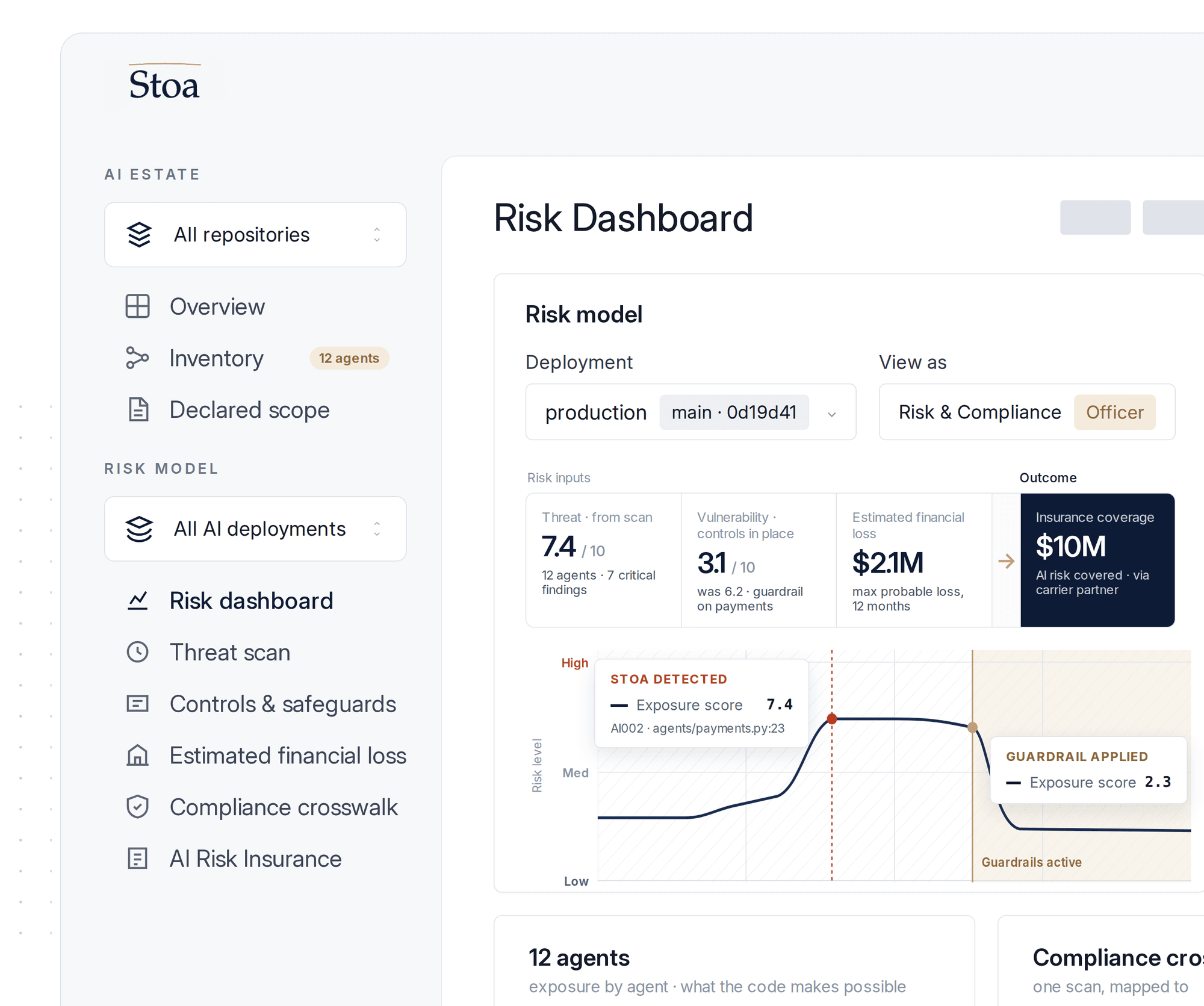
Stoa identifies potential risks within your AI systems, establishes strategic guardrails, and maps your unique needs to the right coverage through our established insurance partners.
Our solutions
How Stoa unlocks secure AI adoption for enterprises
Risk assessments & evaluations
Know every agent. Score every exposure.
Stoa AI Risk Scanner inventories every agent, model, tool, and permission in your deployment, traces what each agent can reach, spend, and decide, and scores every exposure on eight risk dimensions so you know where the real risk sits before it reaches production. Stoa AI Risk Guardrails then closes those gaps with verified controls and monitors the deployment so they stay closed.
Risk mapping
Every finding, mapped to the standard that matters.
Each finding is cross-walked to NIST AI RMF, the OWASP LLM and Agentic Top 10, ISO 42001, and the EU AI Act, so the same scan answers your auditor, your security team, and your board. One dashboard shows coverage, open gaps, and owners, giving compliance and risk teams a single picture they can act on.
Underwriting Evidence for Insurance
Turn aggregated risk data into underwriting evidence
Everything Stoa measures is aggregated into a verified, code-level underwriting file, replacing the questionnaire with ground truth from your deployment. Our insurance partners use that evidence to underwrite enterprise AI liability, so you secure coverage that fits the risk you actually run.
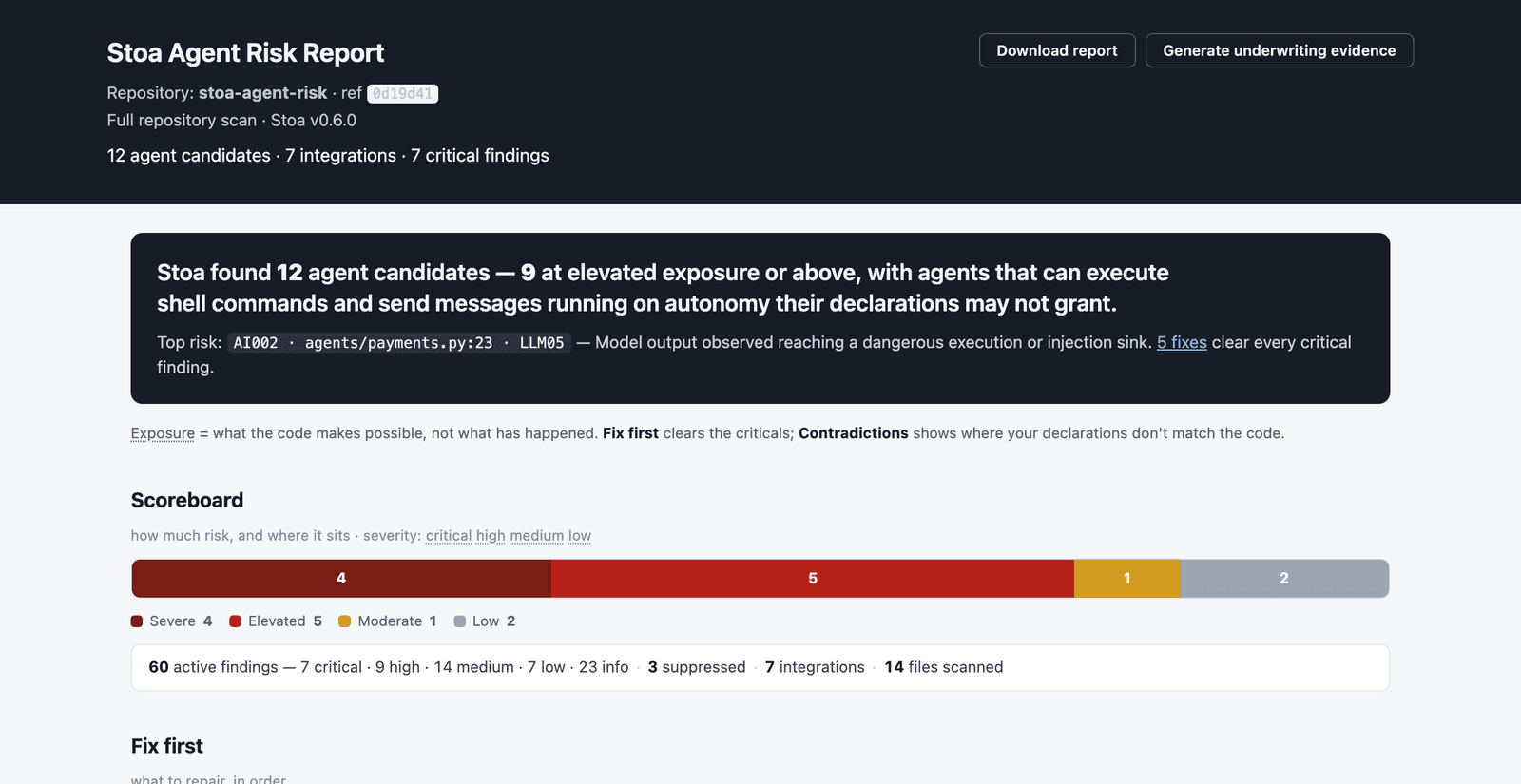
What one Stoa scan uncovers about your AI deployment
Every agent in your codebase, what each one can reach, and which findings to fix first. Ten minutes on a real repository.
The AI risks
The most critical AI vulnerabilities for modern enterprises
The MIT AI Risk Repository catalogs more than 1,700 distinct AI risks. Here are eight that enterprises meet most often.
Source: airisk.mit.eduAI Hallucinations
Your agent states a fact, price, or commitment that doesn't exist, and a customer relies on it.
Prompt Injections
A third party manipulates your agent through its inputs and steers it against you or your customers.
Data Leakage
Confidential or personal data disclosed through model outputs. No breach, no hacker — the system said it out loud.
IP Infringement
Output or training data draws an IP claim: copyright, trademark, trade secrets.
Performance Failure
The AI simply doesn't perform as promised: missed escalations, wrong decisions, negligence claims.
Algorithmic Bias
An AI-assisted decision in lending, hiring, or pricing produces a discriminatory outcome and a regulator's attention.
Erroneous Transactions
An agent-driven error moves money wrongly: payments, refunds, internal transactions.
Data Loss & Corruption
The agent deletes production data or corrupts records; you pay to restore, rebuild, and retrain.
Why now
The carve-out is already underway.
ISO endorsements CG 40 47 and CG 40 48 introduce AI exclusions for Commercial General Liability policies, and major carriers are filing AI liability exclusions with state regulators.
The EU AI Act's high-risk obligations enforce from August 2026.
The same carve-out pattern created the standalone cyber market twenty years ago. AI risk is being carved out now — before dedicated capacity is broadly available.
Common questions
What the research says about AI risk and insurance.
The questions teams raise before a renewal, answered from published market research — each with its source.
Isn't AI risk already covered by my existing cyber and E&O policies?
Not reliably. Marsh finds generative-AI exposure runs across virtually all lines of commercial insurance — cyber, tech E&O, media, D&O, employment practices, IP, general and product liability — not just cyber. And as Insurance Thought Leadership puts it, many of those AI risks are “sitting silently inside existing policies, often unpriced, unmanaged, and waiting to materialize,” because AI losses don't map cleanly onto traditional lines.
Source: Marsh · Insurance Thought Leadership
Is AI failure a real, claimed risk yet — or still hypothetical?
It is already producing claims. Fact.MR projects AI-related legal claims worldwide to exceed 2,000 by the end of 2026, and identifies hallucinations and errors as the single largest driver — roughly 31% of the emerging market — alongside rogue autonomous actions and bias in lending and hiring. The Geneva Association describes the core failure mode plainly: models that “confidently output false or misleading information” or inadvertently replicate copyrighted content.
Source: Fact.MR · The Geneva Association
What does “silent AI” mean, and why does it matter?
It is coverage that was never affirmatively written for artificial intelligence — the form simply didn't contemplate it. Insurance Thought Leadership describes these as risks “sitting silently inside existing policies, often unpriced, unmanaged, and waiting to materialize.” Whether such a policy responds is then decided at claim time rather than before it, which is precisely the ambiguity an assessment is meant to remove.
Source: Insurance Thought Leadership
Is AI risk even insurable?
Partly, and unevenly — which is the point of assessing it. The Geneva Association flags three insurability obstacles: an excessive maximum possible loss from widespread failures, large average losses from events like misinformation or regulatory fines, and severe information asymmetry over how a business actually governs its AI. The market is responding three ways at once: AI endorsements bolted onto cyber and E&O, new underwriting (including parametric triggers), and standalone products such as Munich Re's aiSure.
Source: The Geneva Association
How is this risk actually underwritten — and why a specialist broker?
Through technical translation between how a system works and how a policy is worded. Fact.MR reports that specialist brokers and MGAs already hold roughly 46% of this market on the strength of that underwriting expertise, and the Geneva Association notes insurers increasingly approve cover only after “scrutinising insureds' AI systems and governance practices.” A broker that doesn't issue its own paper can run that scrutiny on your behalf and place across markets.
Source: Fact.MR · The Geneva Association
Does stronger AI governance lower my insurance cost?
It is the lever the research keeps returning to. Insurance Thought Leadership argues that robust governance, transparent validation, and continuous monitoring both reduce insurance costs and demonstrate trustworthiness to underwriters — treating “the whole workflow from data pipelines to prompts and APIs as the governed unit.” The Geneva Association expects insurers to require human oversight, bias checks, model audits, and reporting as conditions of cover. Our governance score is built from exactly those controls.
Source: Insurance Thought Leadership · The Geneva Association
Sources
- Marsh — “Generative AI: three myths about this pertinent risk” ↗
- The Geneva Association — “Gen AI risks for businesses: exploring the role of insurance” (2024) ↗
- Insurance Thought Leadership — “Managing and Insuring Generative AI Risks” ↗
- Fact.MR — “AI Agent Liability Insurance Services Market” (2025) ↗
AI risk management and coverage